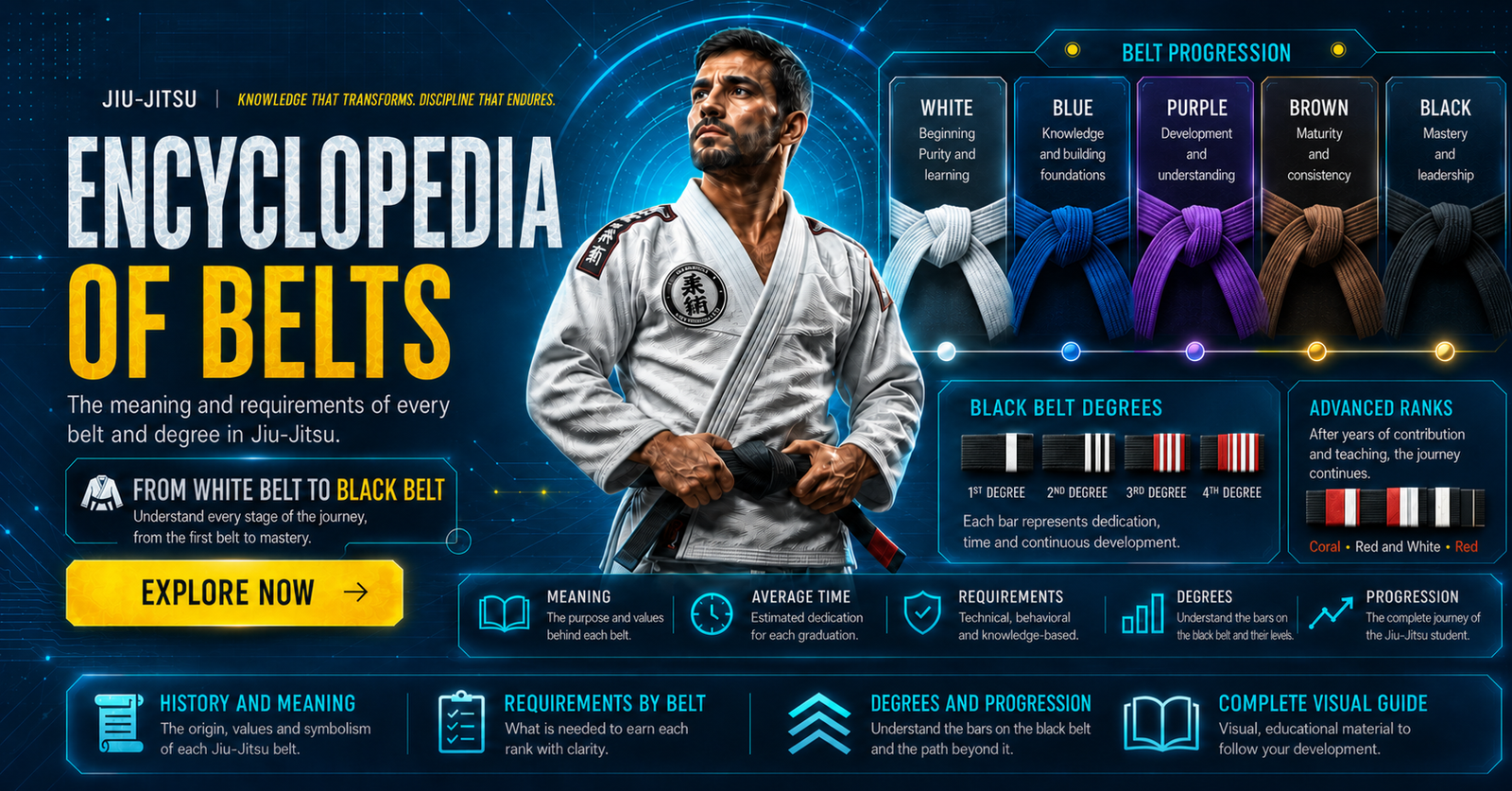
Few martial arts have a belt hierarchy as recognized outside the mat as Jiu-Jitsu does. But behind the color on the hip exists a system with rules, minimum time...
As global Jiu-Jitsu grew, so did an annoying problem: people presenting themselves with belts — including black belts — without real technical backing. Understa...
Every black belt, without exception, was once a white belt. It is in this belt that most people truly experience Jiu-Jitsu: the feeling of being dominated by so...
Before reaching blue belt, every child who practices Jiu-Jitsu goes through its own graduation system, designed for the body, attention, and maturity of those b...
Three words that constantly mix up in Jiu-Jitsu vocabulary: graduation, certification, and affiliation. Each one solves a different problem, and understanding t...
Before changing color, the Jiu-Jitsu practitioner accumulates small bars at the end of the belt — the degrees. They mark time within a color without yet justify...
Blue belt has an unflattering nickname among Jiu-Jitsu practitioners: "blue belt blues" — the phase when initial enthusiasm cools, real life demands your time b...
"How long does it take to become a black belt?" is probably the most asked question by those starting Jiu-Jitsu. The answer has an objective part — the minimum...
Changing a student's belt is one of the most responsible acts within Jiu-Jitsu — and cannot be done by just anyone. There is a minimum authority rule, a traditi...
At 16, the practitioner who spent childhood in the children's colored-belt system faces one of Jiu-Jitsu's most profound changes: leaving green belt and enterin...
Reaching blue belt is the first major validation of the journey: the instructor recognized that the fundamentals of survival and defense have been absorbed, and...
Reaching coral belt is not a matter of technique — it is a matter of decades. Red and black, the 7th degree marks the moment when a Jiu-Jitsu master officially...
Purple belt is often described by experienced instructors as the watershed between "knowing Jiu-Jitsu" and "understanding Jiu-Jitsu". It is in this belt that th...
Brown belt is, for most practitioners, the final major station before black belt — and is usually experienced with a mix of technical confidence and personal ac...
Seven years after reaching coral, a handful of Jiu-Jitsu masters reach an even rarer level: the red and white belt, the 8th degree of black belt. Understand wha...
Black belt typically takes, on average, about ten years of consistent training to achieve — and it is simultaneously a destination and a new beginning. Destinat...
At the absolute top of the Jiu-Jitsu graduation system stands the red belt, divided into two degrees: the 9th, granted individually to specific masters, and the...
Why does Jiu-Jitsu use white, blue, purple, brown, and black — in that order? The real answer comes from direct inheritance from Jigoro Kano's judo, not the mos...