


Encyclopedia of Jiu-Jitsu
⚖️Rules and Arbitration
How scoring, penalties and victory criteria work.
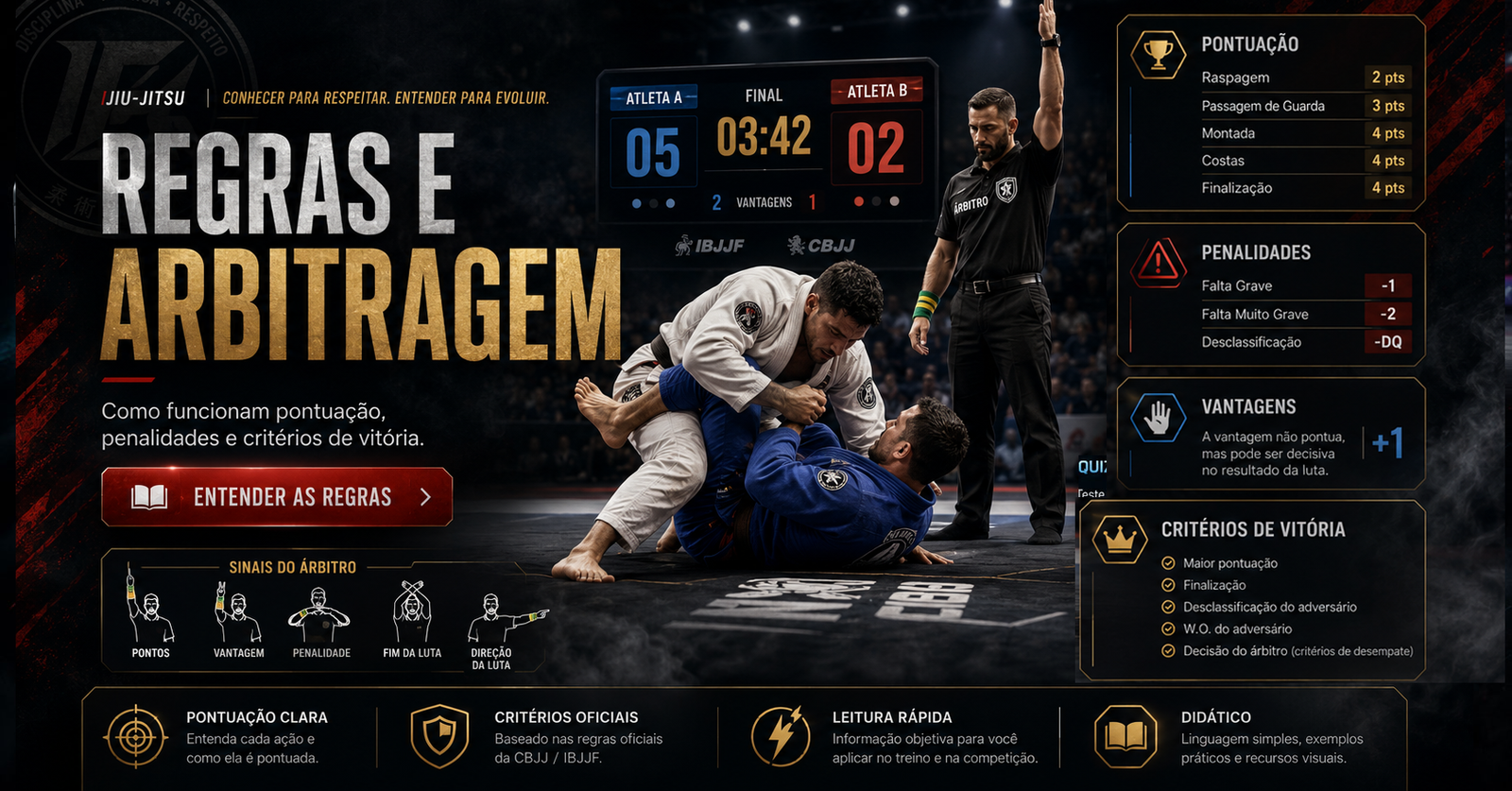
In a close match with no submission and a tied point score, who wins? Often, whoever has more advantages. Understand what this "lesser" scoring unit is, when th...
A Jiu-Jitsu match can end by submission—but most don't. In the absence of a submission, the score card decides: a point system that rewards those who advance po...
During a match, the center referee doesn't talk much—they show. Each raised arm, each closed fist, each whistle blast has an exact technical meaning within the...
The gi is not just a uniform: it's part of the game itself. Collar, sleeves, and pants become grips, levers, and traps—that's why the gi rule is detailed down t...
The mat is not an infinite space. Every Jiu-Jitsu competition defines a combat zone and a safety border around it—and what happens when an athlete crosses that...
Time runs out, no one submitted, and the score is exactly tied. So now, who wins? Sport Jiu-Jitsu has a clear order of tiebreaker criteria—points first, then ad...
That academy emblem, the sponsor patch, the country flag: all of this has the right place on the gi—and the wrong place that fails inspection. Understand the zo...
Removing the gi is not just changing clothes—it's competing under a different set of rules. Collar grips disappear, leg game gains an entire arsenal that doesn'...
Not all fouls in Jiu-Jitsu are the same—and the rule reflects this with a ladder of sanctions starting with a verbal warning and ending in disqualification. Und...
Tapping—the famous "tap"—is probably the most important rule in all of Jiu-Jitsu, and the least understood by those watching from outside the sport. It's not a...
A white belt match lasts half as long as a black belt match—and a master 5 match lasts even less, even between black belts. Match time in sport Jiu-Jitsu is not...
No collar, no fabric pants—but that doesn't mean "no rules." In no-gi, the uniform changes material and gains its own rules for color, fit, and safety. See what...
Weight determines your opponent before the fight even begins. Understand how sport Jiu-Jitsu divides competitors into weight categories, how the gi weighing wor...
No other submission family in Jiu-Jitsu has rules as detailed as leg locks. The straight ankle lock is allowed from white belt; kneebar and toe hold only at bro...
Straight ankle lock from white belt, but kneebar only from brown belt onward. Wrist lock released at blue belt, but neck locks prohibited for everyone, always....
Not every escape technique is allowed—and some aren't even escape attempts; they're simply too dangerous for the rules to accept. Slams, neck cranks without cho...
Holding a position without doing anything, minute after minute, is also a foul in Jiu-Jitsu—even with no illegal techniques involved. This foul is called stalli...
Some fouls in Jiu-Jitsu don't go through warnings or point deductions—they remove the athlete from the match immediately. And when a competitor, corner, or acad...
An 8-year-old child and a 35-year-old adult should never face each other on the mat—and sport Jiu-Jitsu organizes this with well-defined age divisions, from pee...
Not every Jiu-Jitsu competition works the same way. There are single-elimination brackets by weight, an unlimited weight absolute category, team competitions, s...
An 8-year-old child and an adult white belt don't compete under the same rules, even at the same belt level. Children's and youth Jiu-Jitsu has its own rule fra...