


Encyclopedia of Jiu-Jitsu
🧩Positions and Safety
Injury prevention and safe training practices.
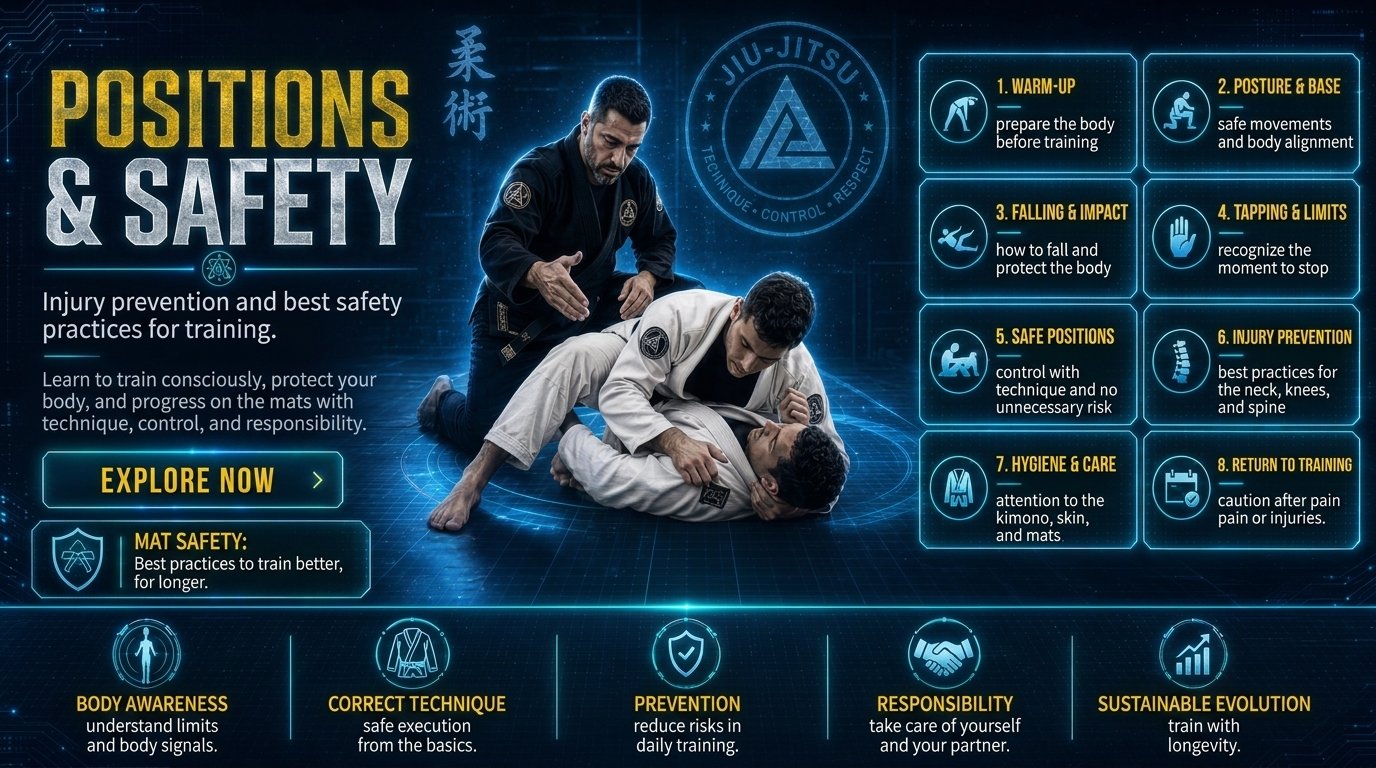
Before learning any submission, every Jiu-Jitsu practitioner must understand one more fundamental idea: not every ground position is worth the same. There is a...
Few images summarize Jiu-Jitsu as well as someone sitting on the trunk of an opponent, controlling every escape attempt. This is the mount — one of the most stu...
If there is a position that experienced practitioners treat almost like the end of the match, it is back control. Being behind the opponent, with hooks locked i...
Before reaching the mount or the back, most practitioners pass through an intermediate stop — and it has a nickname: "side control". Alongside knee-on-belly, th...
No position defines Brazilian Jiu-Jitsu for outsiders as much as the guard. It is the position that allows someone lying on the ground, with the opponent betwee...
Passing the guard is the move that opens the door to Jiu-Jitsu's entire hierarchy of positions: while the opponent maintains the guard, they always have some to...
Every Jiu-Jitsu position — from guard to back control — ultimately depends on the same three ingredients: well-directed weight, leverage instead of brute streng...
Every Jiu-Jitsu fight begins standing, but almost never ends there. Before guard, mount, or submission exists, there is a decisive moment — often ignored by tho...
Before learning to attack, every Jiu-Jitsu practitioner must learn to survive — and surviving on the ground means knowing how to get out from the bottom. Being...
A black belt and a beginner may pass through the same positions — mount, side control, back control — and still seem like they are playing different sports. The...
One of the most repeated nicknames in Jiu-Jitsu is "human chess" — and the comparison is not just a catch phrase. Just like in chess, the value of an isolated m...
If there is one position that sums up the identity of Brazilian Jiu-Jitsu for outsiders, it is the guard — the ability to attack, control, and even win a fight...
Taking off the gi does not just change the uniform — it changes Jiu-Jitsu's entire positional vocabulary. A practitioner who masters the same position two diffe...
Choke is the oldest submission family in Jiu-Jitsu and also the most varied: there are moves that depend on gi fabric, moves that work on a naked body, versions...
After chokes, arm locks form the second great family of Jiu-Jitsu submissions — and perhaps the most varied in mechanism: some twist the elbow in a straight lin...
No family of Jiu-Jitsu submissions is as discussed — and regulated — as leg locks. Much of this comes from a simple detail of physiology: the knee tolerates far...
Jiu-Jitsu is a sport of intense physical contact, and no list of precautions eliminates 100% of injury risk — but most avoidable incidents on the mat repeat for...
The neck, knees, and elbows are the points of the body most exposed during a submission — and also the ones that require the fastest safety response when the mo...
Jiu-Jitsu is one of the sports with the most skin-to-skin and tissue-to-tissue contact among practitioners — which makes hygiene as important a concern as techn...