


Encyclopedia of Jiu-Jitsu
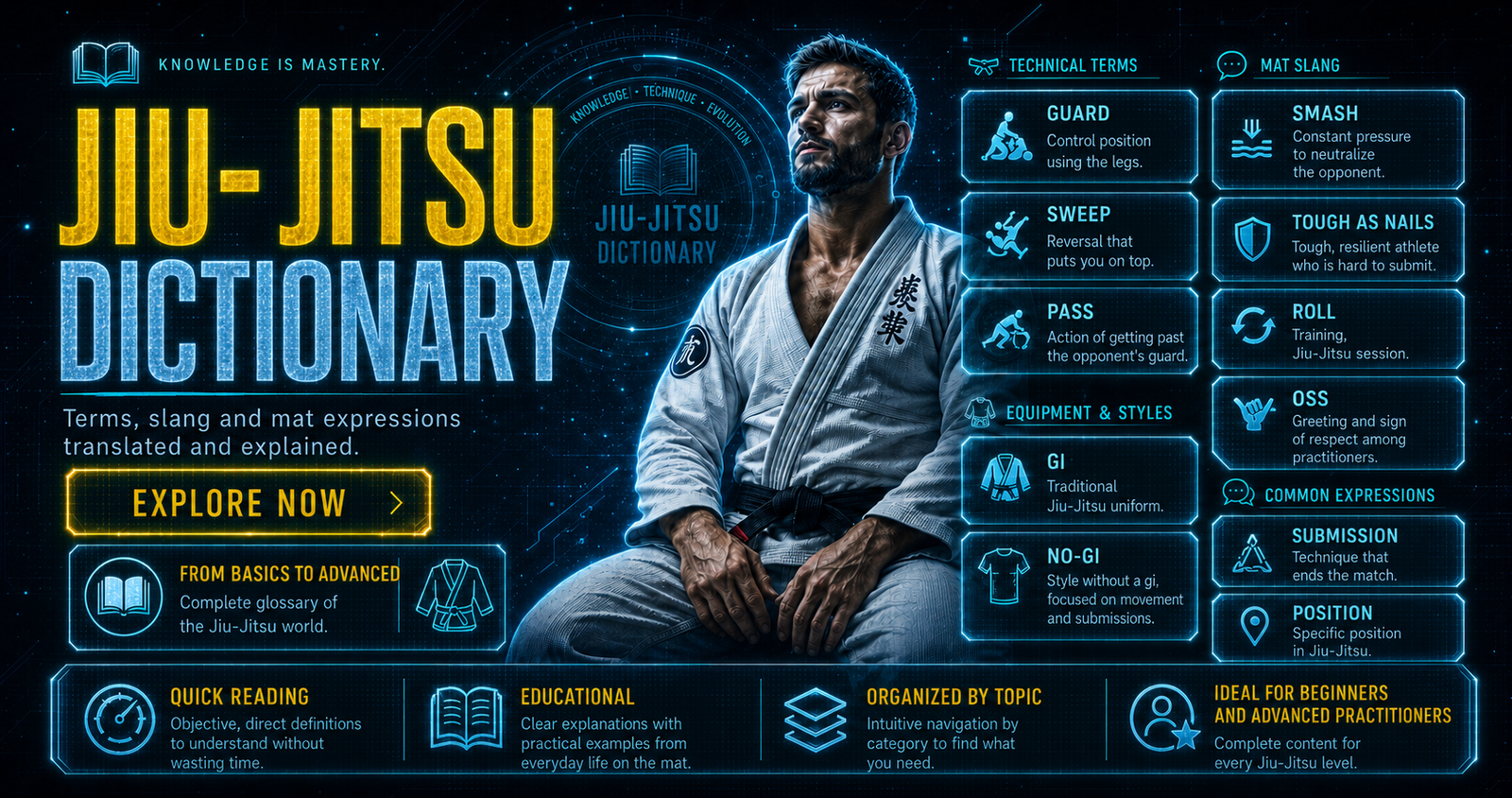
📖Jiu-Jitsu Dictionary
Terms, slang and mat expressions translated and explained.
A
It's the category where weight is no longer a criterion: in the "absolute" (or open class), athletes...
"Anaconda" is the arm choke applied from above an opponent in the four-point position, wrapping the...
Two athletes in exactly the same position can be in completely different situations depending on one...
Not every takedown requires a deep dive into both legs. The ankle pick takes down the opponent by "s...
"Pull the arm and come out behind" is one of the most repeated instructions in wrestling and modern...
"Armlock" is the umbrella term for any lock that attacks the elbow by extending the arm beyond its n...
The opponent's leg entangled between yours, their hip immobilized for the joint attack: ashi garami...
"Ankle lock" is the umbrella term for submissions that directly attack the ankle joint — from the mo...
Before any armlock works, the limb needs to be removed from the scene: "arm isolation" is the proces...
It's not a move, not a position, it's a style — or rather, a reputation. "Aggressive competitor" is...
B
Every path in Jiu-Jitsu that ends behind the opponent, with hooks locked in, is called the same thin...
"Go baiana!" is a common shout at the edge of the mat in gyms all over Brazil — and has nothing to d...
"Watch your base!" is probably the most repeated correction in any White Belt Jiu-Jitsu class. Simpl...
Few terms divide as much opinion in Jiu-Jitsu as "berimbolo" — a name of Brazilian origin that becam...
"Bicep slicer" is the compression lock that bends the opponent's elbow backward, crushing the bicep...
Wrapping the opponent's entire torso and locking your own hands behind their back is one of the simp...
"Botinha" is the Brazilian popular nickname for the straight ankle lock, the most basic ankle lock a...
"Bread cutter" is the choke applied from side control, using the forearm to pressure the opponent's...
Two hooks, a hip thrust and an arm pull — the sweep most associated with butterfly guard is also one...
Before any match happens, someone needs to decide who faces whom: the "bracket" is the elimination f...
Hooks locked on the opponent's waist, their body pinned to yours, and their neck free for the most f...
"That guy gives trouble" is one of the biggest indirect compliments a practitioner can receive from...
It's the piece of fabric tied over the gi that sums up, in a single color, years of training and tec...
Sitting up, with two foot hooks inside the opponent's thighs: butterfly guard is one of the most ver...
It is the most basic escape movement in Jiu-Jitsu, taught in the first class: the "bridge" (also cal...
"Break their base!" is one of the most common shouts from any instructor watching a sweep in progres...
C
"Calf slicer" is the compression lock that bends the opponent's calf against their own knee or shin,...
"Can opener" is the technique of pulling the opponent's head to force the opening of the closed guar...
Lying perpendicular to the opponent, chest to chest with no breathing room: the nickname "cem-quilos...
Rarely does a single takedown entry work alone against an opponent who knows how to defend. "Chain w...
"Compression lock" is the submission category that crushes a muscle against a bone instead of forcin...
One hand on the collar, the other on the sleeve: collar-sleeve is the most basic and most versatile...
The opponent's two arms isolated at once, one by the legs and one by the arm: the crucifix completel...
Rear naked choke, guillotine, triangle — different names for the same central principle in Jiu-Jitsu...
"Crucifix choke" is the submission applied from the crucifix position, where the opponent's two arms...
Legs locked around the opponent's body, heels crossed on their back: closed guard is the oldest and...
"That game is pure craftiness" describes a specific type of practitioner — smarter than strong, more...
Few physical marks are as associated with grappling as cauliflower ear. In Jiu-Jitsu, it became almo...
"Clock choke" is the nickname for the choke applied from behind against an opponent in four-point po...
D
"D'Arce" is the choke that wraps the opponent's neck and arm from underneath, fitting their body bet...
Your entire body underneath the opponent's hip, hidden under their leg: deep half guard transformed...
It's the maximum punishment in competitive Jiu-Jitsu: the immediate removal of an athlete from the m...
"Dojo" is the Japanese word for the place where you train — and in Jiu-Jitsu, it coexists alongside...
"Let's drill this guard pass twenty times" is a sentence any regular Jiu-Jitsu student has heard hun...
It's the small stripe sewn or painted on the tip of the belt — and to outsiders, it seems just an ae...
One hook behind the opponent's leg and the hand gripping the ankle: De La Riva guard is one of the m...
E
F
The name comes straight from fire rescue: carrying an entire person over your shoulders to remove th...
"Finger lock" is the submission that directly attacks the small joints of the fingers, usually appli...
"Use your frame!" — perhaps the most repeated instruction for someone being pressed on the mat. Fram...
It's the thin tape wrapped around the fingers before training or fighting: "finger tape" gives extra...
"Let's do a flow roll" is the most relaxed invitation you can receive on the mat. Without forced res...
"Flying triangle", "flying armlock" — few images in Jiu-Jitsu are as striking as a practitioner jump...
It is the piece that replaces the gi pants when Jiu-Jitsu is practiced without gi: "fight shorts" ar...
G
"He went out" is the direct, almost dry way the mat describes the moment when a choke is applied too...
It's one of the simplest and strongest grips in all grappling: two hands interlocked, palm to palm,...
"Watch out or you'll gas out" is one of the most repeated pieces of advice for someone starting to c...
It's the most recognizable uniform in Jiu-Jitsu — thick collar, reinforced fabric, belt tied at the...
An opponent's arm bent and wrapped over their own body, like a gift package: gift wrap neutralizes t...
Few surnames carry as much weight within a sport as "Gracie" carries in Jiu-Jitsu. More than a famil...
Not every gi weighs (or costs) the same: "gram-weight" is the measure of fabric weight per area, usu...
Long before berimbolo went viral in Jiu-Jitsu, wrestling already used a diagonal roll to escape and...
It's the position that makes Jiu-Jitsu a different game from any other fight: lying on your back, th...
"It's hard to pass" is the most common complaint from those training against someone with a good gua...
Before any sweep, guard pass or submission happens, there's almost always a silent and constant disp...
"Let's go light today" is one of the most important combinations two practitioners make before rolli...
Before any match, an athlete's gi goes through an inspection: the "gi check" verifies that the fabri...
H
It's the movement that teaches your body to "slip" on the floor without having to stand up: the "hip...
"Lock your hooks!" is the decisive instruction the moment a fighter reaches his opponent's back — an...
Before any takedown entry, collar grip or dominant grip, there's a silent struggle of hands trying t...
"Heel hook" is the leg lock that rotates the opponent's foot, twisting the knee by rotation instead...
Between the single leg and the double there's a leg entry that attacks higher, almost at the opponen...
A hip jump and one hand on the ground is enough to drop an opponent sitting inside your closed guard...
Many different sweeps share the same hidden motor: a leg hook that controls the opponent from inside...
Only one leg of the opponent trapped between yours: half guard is the most studied intermediate posi...
It is the padded fabric piece held by a strap under the chin that protects the ears from constant ma...
"Head scissor choke" is the choke applied with the legs closing around the opponent's neck like scis...
"Today's training got hot" is the kind of comment any practitioner has already heard (or made) leavi...
I
Body turned upside down in relation to the opponent, supported on shoulders and back of the head: in...
"Inverted omoplata" is the variation of the omoplata applied with the body turned to the opposite si...
Not every black belt who teaches is called a "master" — and this difference is not accidental. In Ji...
J
K
One leg crossed behind the opponent's knee and the other locking the hip: K-guard is the bridge betw...
One knee driven into the opponent's abdomen, the other foot on the ground for total mobility: knee o...
Every armlock, every kimura, every leg lock in Jiu-Jitsu belongs, in the Japanese origin of technica...
It's one of the oldest and most taught holds in all of grappling — the first that most judokas learn...
"Kimura" is the established name of the shoulder lock in which the opponent's arm is bent behind the...
Not every takedown needs to involve the opponent's legs with the arms. The knee tap drops with almos...
There's a much smaller and more discreet version of o-uchi, used almost like a test before the main...
If you've heard about "kuzure-kesa-gatame" and were in doubt about what changes compared to regular...
Before any throw, sweep or submission works, something needs to happen first: the opponent needs to...
L
It's the physical principle that explains why someone weighing 60kg can submit someone weighing 100k...
"Close the lock!" is what you hear in the first week of any beginner Jiu-Jitsu class — long before t...
"Armlock", "leg lock", "wrist lock" — the word "lock" appears so often in Jiu-Jitsu vocabulary that...
"Leg lock" is the umbrella term for any submission that attacks the knee, ankle or hip — a family of...
"Locked it in and there was no way out" describes exactly the kind of submission every practitioner...
One leg wrapped around the opponent's own arm, trapping the elbow against the body: lasso guard tran...
It's the reinforced edge that runs along the front of the kimono jacket — originally designed only t...
Before any takedown entry works, the hip needs to drop without posture collapsing. "Level change" is...
When the passer stands up inside the guard, thinking they're safe, there's a sweep designed exactly...
Before any lock or sweep on the ground, many fights are decided while still standing — and the leg s...
M
It's small, discreet and almost always required before stepping on the mat: the "mouthguard" protect...
"He's my mat brother" is one of the most affectionate ways Jiu-Jitsu practitioners describe the bond...
Sitting on the opponent's torso, controlling both sides of the body with the knees and free to attac...
N
Before any guard dispute exists, someone needs to put the opponent on the ground. "Nage-waza" is the...
If there's a single Japanese term that sums up what Jiu-Jitsu is, in its origin, that term is "ne-wa...
It's Jiu-Jitsu without the kimono — rash guard, shorts, no collar or lapel to grab — a modality that...
Heads in opposite directions, chest on the opponent's face: the north-south position is one of the m...
"North-south choke" is the choke applied from the north-south position, with the chest of whoever is...
O
Loose legs, hooks, gi grips and angles replacing simple locks: open guard is the umbrella that shelt...
In the hallway of any academy that mixes judo and Jiu-Jitsu, it's common to hear just half the name:...
While o-soto attacks from the outside, there's a sister throw that attacks exactly the opposite way:...
Despite its name, it's not a forgotten ancient technique — "old school" is one of the sweeps most as...
Before mounted position, heavy top control, or kesa-gatame existed as individually named techniques,...
One arm over the opponent's shoulder and the other under their arm: the over-under is one of the mos...
It is the arm control that always walks alongside the underhook — just in the opposite direction. "O...
P
"That fit nicely" is the comment any instructor makes when a technique comes out exactly as it shoul...
"That's a paper black belt" is one of the harshest criticisms you can hear in the Jiu-Jitsu communit...
When an athlete fails to engage, commits a minor infraction or uses a technique banned for the categ...
"Paper cutter choke", also known by the nickname "papacatch", is the choke applied from a head-and-a...
It is the embroidered or sewn "business card" on the gi: "patches" show, at first sight, which team,...
It is the most common fabric weave in modern competition gis: the "pearl weave" forms a pattern of s...
It is the basic unit of scoring in competitive Jiu-Jitsu: each position of dominance recognized by t...
It's the first thing any instructor corrects in a beginner inside the guard — and the last thing a h...
It's not about striking with force or being heavy: "pressure" is the ability to distribute your body...
It is the movement of "swimming" into the clinch by trading arm grips with the opponent until gettin...
R
It's the only person authorized to award points, mark advantages, assess penalties and decide a tied...
Your own leg passing behind the neck, breaking the opponent's posture until your body's rubber band...
"Rear naked choke" is the Brazilian name for the choke applied from behind the opponent, considered...
Randori is the Japanese word for free training within judo tradition — the moment when technique lea...
It is the tight-fitting shirt that became an obligatory part of the no-gi uniform: the "rash guard"...
The same hook behind the opponent's leg, just turned to the other side: the reverse de la Riva opens...
"Reap" is the name given to hooking your own leg into the opponent's leg beyond the allowed angle, p...
Trapping only one arm of the opponent with both hands might seem small, but it usually amounts to mo...
"That athlete represents their team" goes far beyond the custom rash guard or personalized gi worn i...
S
"Stop stalling the fight!" is one of the most predictable rebukes an referee gives in any Jiu-Jitsu...
"Shoulder lock" is the umbrella term for submissions that force the opponent's shoulder beyond its n...
Before points, colored belts and tournaments existed, Jiu-Jitsu was already being taught with a sing...
"Submission" is the word that summarizes the end goal of almost every Jiu-Jitsu technique: to force...
Feet pushing the opponent's biceps like two spider legs: spider guard uses the gi sleeves to control...
"I'm sore" is practically a greeting between Jiu-Jitsu practitioners the day after a good training....
One leg crossed over the opponent's body, drawing an "S" with the other: the S-mount is the mounted...
The opponent's leg crossed as if mounted in a saddle: the saddle became the most influential leg con...
"Sankaku" is the Japanese word for triangle — and gives its name to one of the most iconic submissio...
"Schultz choke" is the choke applied from the front headlock, with the opponent's head trapped benea...
Not every position exchange in Jiu-Jitsu is organized — sometimes everything happens too fast to cal...
It is the grip that keeps the back trapped: one arm over the shoulder, the other under the opponent'...
Turning your back to your own opponent seems like a basic error — until you understand that this is...
Every choke submission in Jiu-Jitsu — from the rear naked choke to the triangle, including the guill...
"Shot" is the wrestling term for the exact moment of a takedown attack — the instant when the practi...
Only one leg trapped between the practitioner's legs, lifting the opponent's ankle: the single leg X...
"Slam" is the action of lifting the opponent off the ground and throwing them hard to escape a submi...
A head pulled down suddenly breaks any standing posture, no matter how strong the opponent is. The s...
They are the tight-fitting pants worn underneath (or in place of) shorts in no-gi: "spats" cover the...
When an opponent dives toward your legs, there is an almost automatic response taught in every wrest...
"Stalling" is what competitive Jiu-Jitsu calls avoiding the fight instead of fighting: staying still...
"Sub-only" is the competition format where points and advantages simply do not exist: the only way t...
The name sounds dramatic, but it only describes how it feels for those watching from the outside: a...
Not every Jiu-Jitsu match is part of an elimination bracket: the "superfight" is an isolated confron...
It is probably the first sweep that any white belt hears by name in their own language. "Scissor" de...
The fighting area is not just the central mat: around it there is a band of different colored materi...
T
"Welcome to the Gentle Art" is how many instructors greet new students in the first class. Jiu-Jitsu...
"That guy has thick skin" is one of the greatest compliments you can give a Jiu-Jitsu practitioner —...
When a match ends with an exactly tied score — including 0 to 0 — competitive Jiu-Jitsu doesn't deci...
"He plays very well from the bottom, but from the top not so much" is the kind of technical analysis...
"Takedown" is the English term, coming from wrestling, for any technique that brings the opponent to...
On four points, body rolled up protecting the neck and abdomen: the turtle position is the last line...
It is the safest way to get off the ground and return to standing with the opponent in front: the "t...
The same sweep that works perfectly in one moment can fail completely a second before or after: "tim...
The name evokes a cutting and rotating blow — and that is exactly how it feels for those who suffer...
In any technical demonstration — in judo, Jiu-Jitsu, or other Japanese martial arts — there are alwa...
"Triangle" is the name of the choke in which the fighter's own legs form a loop around the opponent'...
Three support points are enough to knock down an opponent in front: both hands on the ground and one...
One of the opponent's legs bent and trapped between yours while they are face down: the truck is the...
"Twister" is the submission that combines spine rotation with ankle pressure, applied from the truck...
U
"Ude garami" is the original Japanese name for the family of locks that intertwines and rotates the...
It is the partner who receives the technique — who falls from the projection, who feels the lock, wh...
Before learning to grapple on the ground, every Jiu-Jitsu practitioner must learn to fall without ge...
Few clinch controls are as valued in no-gi Jiu-Jitsu as the underhook — the arm passed under the opp...
V
W
"Wrist lock" is the name given to any submission that directly attacks the wrist joint, forcing the...
The free leg passing behind the trapped knee, creating a second lock point within half guard: Willia...
The opponent's own lapel wrapped on their back and trapped under the leg of whoever is attacking: wo...
"Congratulations, warrior!" is practically a standard phrase on the Brazilian mat — said to whoever...
Before stepping on the mat, an athlete registered in a weight category must prove they belong to it:...
The image is literal: one leg of the opponent lifted over the shoulder, as if it were a tray carried...